

Joseph Urbach
Neuss
1889 -
Essen-Werden
1973
Born in Neuss in 1889, Josef Urbach trained from 1905 until 1910 at the Düsseldorf School for the Decorative and Applied Arts under Peter Behrens and Fritz H. Ehmcke, whose assistant he became.
After starting out as a commercial artist, Urbach went to Paris and switched to painting as art. He began to study at the Karlsruhe Art Academy but was called up when the first world war broke out, served in the railway administration and was sent to the front in Flanders towards the end of the war.
In 1918 Josef Urbach joined the "Junges Rheinland" group and, two years later, the "Rhenish Secession", linking up in his painting with the Expressionism of the Rheinland school. Urbach's teaching career began at the Essen School for the Decorative and Applied Arts in 1914 and continued when he was appointed professor in 1923 at the Folkwang School in Essen 1923.
On the side Urbach executed numerous commissions from industry and commerce, primarily portraits and representations of industrial facilities. In the 1930s the Urbach paintings "Pferdeschwemme" and "Stillleben" ["Still Life"] were classified as "degenerate" and removed from the Folkwang Museum.
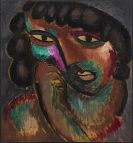
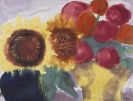
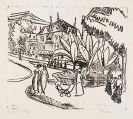
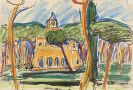
Urbach's studio and all his work, including the inventory catalogue of it, were destroyed in a bombing raid in 1943. Urbach taught classes for drawing, nude studies and portraiture at the Folkwang School. Between 1950 and 1968 Joseph Urbach produced a great many watercolors, sketches and lithographs but only a few paintings in oils and acrylic.
Joseph Urbach died in Essen in 1973. Many of his works are owned by public and private collections in Germany.
![Otto Mueller - Zwei Zigeunermädchen im Wohnraum [historischer Titel]](https://www.kettererkunst.de/still/kunst/picm/22/125000258.jpg)

Would you like to sell a work by Joseph Urbach?
Infos for seller


Starting bid: 4,500 EUR